

The ETF Thematic Investor: Asia Tech - Capital Follows Policy
Summary
- Capital follows policy: When technology becomes strategically important, Asian governments have a strong record of building capabilities, coordinating industry and attracting private capital into supply-chains.
- AI sovereignty is the catalyst: Governments increasingly want greater control over compute infrastructure, directing support towards chips, memory, data centres, cybersecurity to power and cooling.
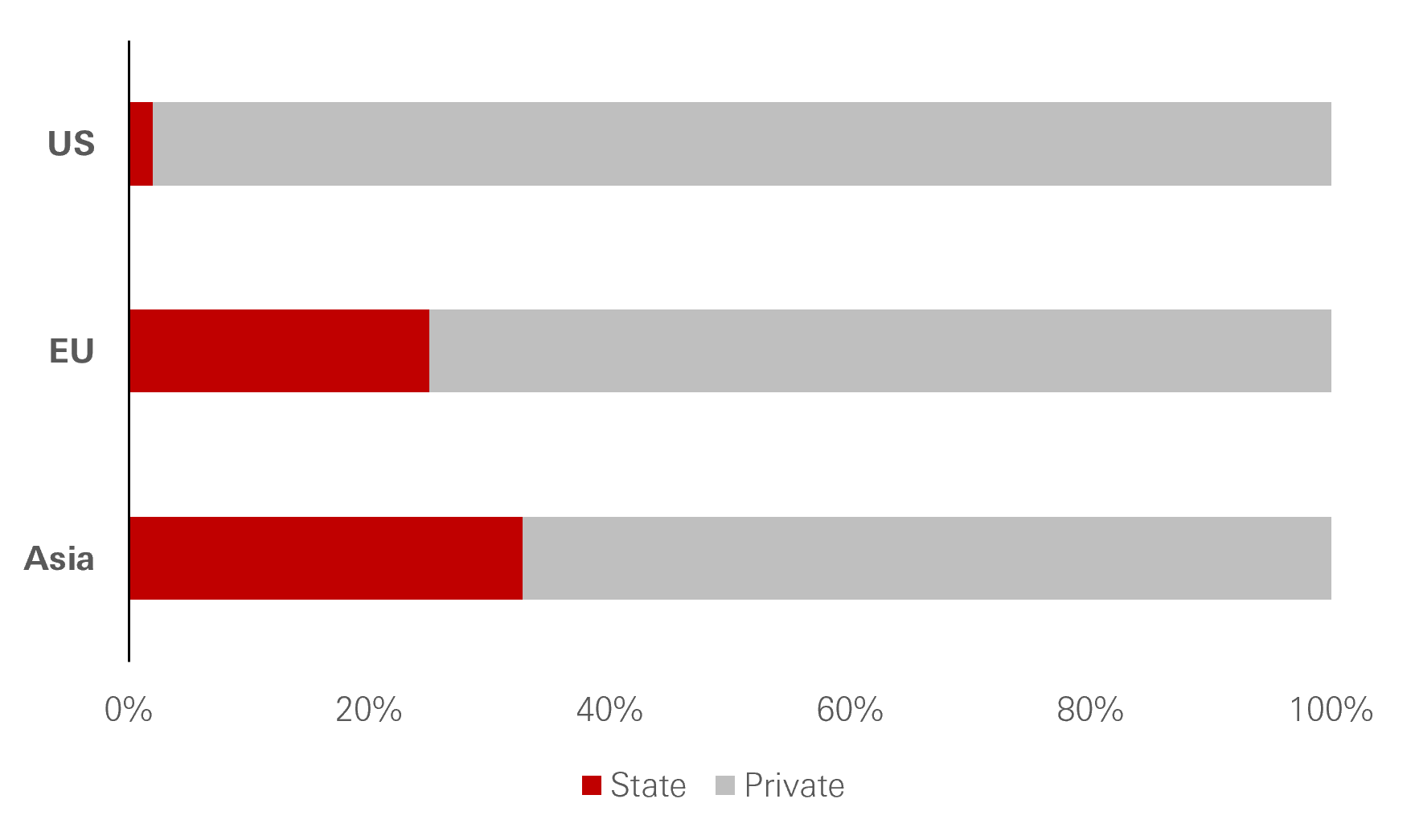
- The state plays a larger role in Asia: Across China, Japan, South Korea and Taiwan, state-linked sources account for around 32 per cent of the AI ecosystem funding identified, compared to 2 per cent in US and 25 per cent in Europe.
- Key takeaway: Follow where policy, private capital and real demand converge, whilst watching overcapacity and geopolitics.
Computing power is national power
Towards the end of 2025, Taiwan’s President Lai Ching-te opened a new national cloud computing centre in Tainan City, with the above phrase. The quote captures succinctly where technology policy is heading.
In our first issue of “The ETF Thematic Investor” series, we looked at Asia tech through the lens of three waves: the post-dotcom internet build-out, the smartphone and mobile internet era, and now the AI infrastructure era. Our conclusion was that tech adoption looks like zeros and ones (digital) but it typically requires a significant physical base supporting it.
With the AI boom, this becomes even more evident. For example, the visible product might be a model, chatbot or app but there exists a hidden infrastructure layer of compute, chips, memory, data centres and clouds, power, cooling and connectivity.
Governments have always cared about the infrastructure that shapes economic power. Throughout history, this meant railways, ports, power grids, telecom networks to defense capacity and energy supply. Later, semiconductors joined the list too. In our contemporary AI era, compute and data infrastructure is shifting towards the same sphere.
For investors, the question goes beyond “who has the best model?” or “who has the best app”. It’s about where the infrastructure gets built, who funds it, who controls it, and which nations treat it as important enough to support. This note highlights how Asian policy is now steering capital into the AI build-out.
Policy capital has built Asia tech before
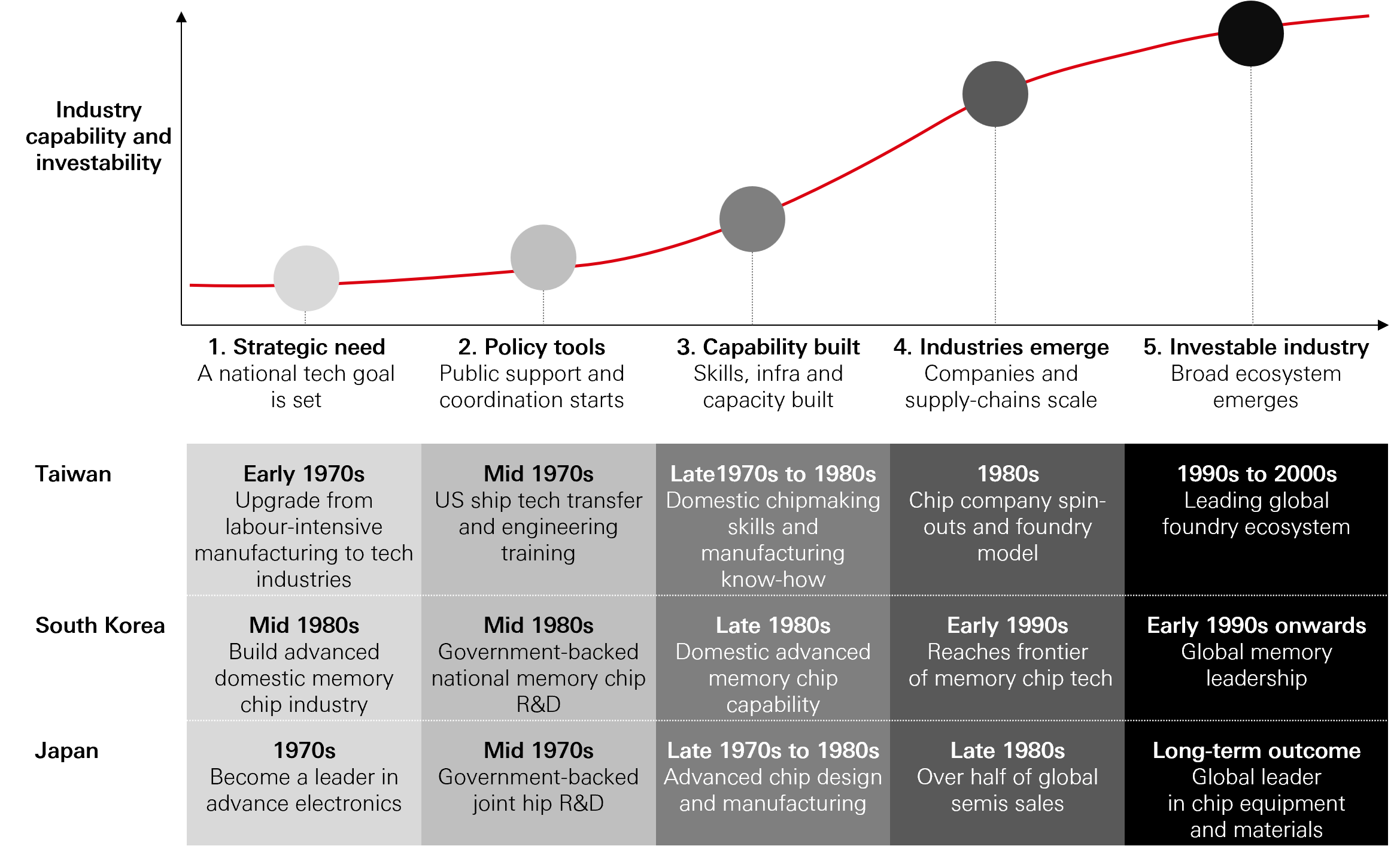
The connection between policy and tech is not new in Asia. Semis are a good example in this. For example, Taiwan didn’t become a world leader in building foundries by accident. Its chip industry was built with heavy state support. In the 1970s, a government-backed research institute bought in overseas chipmaking tech, trained engineers abroad and translated this know-how into a domestic semis industry.
South Korea took a slightly different route. In the 1980s, the government worked closely with large industrial groups and research institutes, using public R&D to move from labour-intensive exports and simple chip assembly to memory-chip expertise. This helped shape Korea’s leadership in memory as it’s known for today.
Japan had its own flavour of this approach. In the 1970s, the government collaborated with companies and research groups, using public R&D and industrial coordination to build expertise in advanced chipmaking. This aided Japan to become a major force in semis, electronics and the equipment and materials required for making chips. See Chart 1 – How strategic tech become investible industries for an overview of how historic state policies took tech from a strategic need to supporting the build-out of industries, in our five-phased Asia Tech Policy Framework.
More recently, China has been using a similar policy playbook. Through their five-year plans, chip-sector policies, tax support and state-backed semis funds, China has been building out more domestic capabilities in chips, chipmaking tools, software and advanced manufacturing. China’s third “Big Fund”, the National Integrated Circuit Industry Investment Fund, was registered in 2024 with around USD47.5bn
Even though every government policy won’t have worked exactly as intended in our illustrations; the commonality is clear. When a tech becomes strategically key, Asian governments have helped build skills, companies and draw capital into the supply-chains around it. This happened with semis. We are beginning to see it happen again as governments treat compute, data centres and the infrastructure needed to run AI as strategic infrastructure.
Chart 1: Asia Tech Policy Framework
How strategic tech became investible industries (eg. semis)
Click the image to enlarge
AI sovereignty is the new reason for policy capital
As governments lean into AI, it’s likely to become embedded in how are economies run. Financial services, factories, hospitals, logistics, public services and consumer services could all become dependent on AI, which makes control of the underlying infrastructure a strategic concern.
That’s the practical idea behind “AI sovereignty”. Countries want greater control over the inputs needed to build and deploy AI, especially compute and the models that run on it. This particularly matters in Asia because the region sits at the centre of the physical AI supply chain (Taiwan in foundries, South Korea in memory, Japan in materials and manufacturing equipment).
But supply-chain strength doesn’t necessarily imply full independence. Taiwan, South Korea and Japan still rely on global customers, foreign chip designers, advanced tools and imported energy. China’s situation is different, it has strong AI ambitions but is trying to reduce reliance on foreign hardware and software, namely GPUs, chipmaking tools, electronic design automation software and parts of the global software ecosystem.
Hence, AI sovereignty gives governments a rationale to support the parts of the tech stack they view as strategically important: from chips and memory, semiconductor equipment, data centres and cloud, cybersecurity, to the power and cooling required to keep it all running. For investors, policy highlights where capital may keep flowing; China’s hard-tech may still be discounted due to export controls and geopolitics, but those same pressures also drive domestic capability-building. The key question is whether markets are too cautious about areas that remain high on the policy agenda.
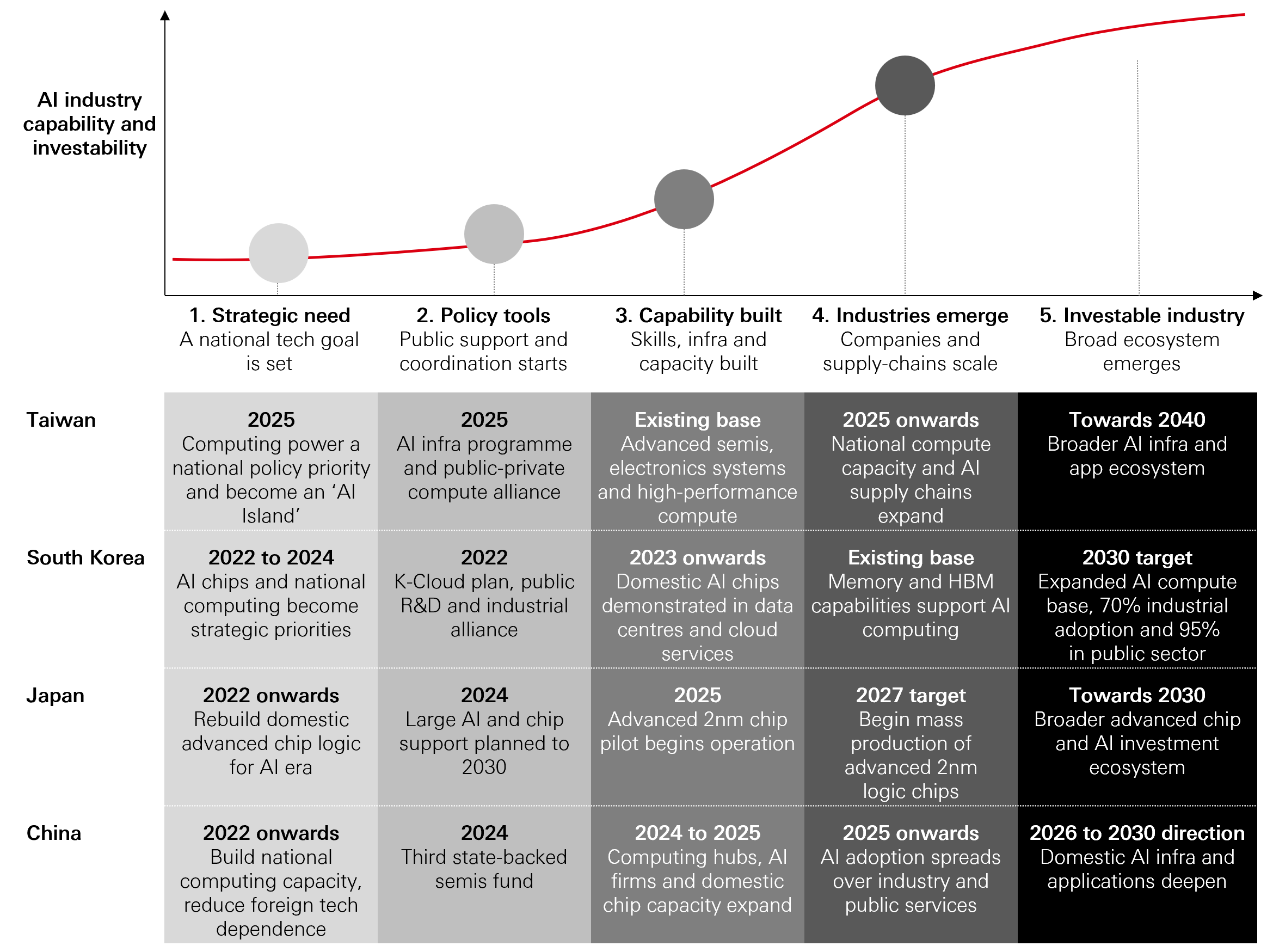
Chart 2: Asia Tech Policy Framework
How governments are supporting build-out of modern AI industries
Click the image to enlarge
China looking for its next growth engines
If one looks globally, China is perhaps the clearest example of policy and tech coming together. The old growth model needs change. Property is no longer the same engine it was, traditional infrastructure has less room for upside surprise than in the early part of the 21st century, and low-cost manufacturing is unlikely to be sufficient for the coming decade.
This is the backdrop for China’s 15th Five-Year Plan. This plan targets at least 7 per cent annual growth in R&D spend, wants core digital economy industries to reach 12.5 per cent of GDP, and proposes 109 major projects across areas such as new quality productive forces and modern infrastructure. Its priority sectors include integrated circuits, AI, robotics, quantum tech, brain-computer interfaces (BCIs), 6G, new energy, new materials and advanced manufacturing.
AI sits directly inside this shift. China wants AI to be useful across factories, logistics networks, hospitals and schools to consumer platforms. Naturally, this makes cost and access to compute important. The DeepSeek moment in 2025 is a useful example. DeepSeek was private-sector led, but its low-cost, open-source approach arrived at the right moment for China’s policy agenda. The recent debate around Moonshot AI’s Kimi models point in the same direction.
However, China has not escaped the need for compute. Strong demand shows compute remains scarce and valuable. But China’s AI path may put more focus on cheaper deployment, open models and practical user cases than a pure competition on who spends the most on frontier models. This path won’t be smooth, but the direction is clear, China is trying to guide more capital towards technologies it sees as essential for the next stage of growth. See Chart 2 – How governments are supporting build-out of modern AI industries above to see how we identified Asian governments have been using policy to support the build of out AI industries through our Asia Tech Policy Framework.
Demographics make automation a macro necessity
Policy is one part of the Asia tech story. Demographics is another. The pressure is clearest in North Asia. Japan has about 29 per cent of its population aged 65 or over, Taiwan crossed 20 per cent in 2025, which makes it a super-aged society, and South Korea faces one of the sharpest projected falls in working-age population within OECD economies.
That accelerates the role of AI, related automation and robotics. In ageing economies, these are not just simply future tech but become practical tools to foster growth when labour is scarce. Factories will need more automation, healthcare needs more digital support, and logistics and services need software that can reduce repetitive work.
From an investors point of view automation isn’t simply about replacing labour, it’s about making scarce labour more productive. This gives AI, robotics and industrial software a stronger macro reason to grow.
Chart 3: Who’s funding the AI build-out?
Estimated regional funding mix highlights greater state backing in Asia
Click the image to enlarge
AI needs power before it needs more apps
The AI build-out has a physical constraint, it required far more electricity. The International Energy Agency estimates that data centres globally used around 415 TWh of power in 2024. By 2030, that could rise to around 945 TWh. This places grids, transformers, switchgear, backup power, cooling systems and long-term power contracts into the AI discussion.
For Asia, this is close to home. Data centre capacity is expanding across the region. Industry real-estate consultant Cushman & Wakefield estimate that Asia-Pacific data centre capacity reached 13.8GW in 2025, with a development pipeline of 19.4GW.
Asia is also exposed to the supply-chain that powers and cools this infrastructure. For example, China is key to solar panels and batteries. Taiwan has depth in power electronics, power supplies and cooling systems. Japan and South Korea have industrial exposure to cables, transformers, high-voltage systems, switchgear and precision components. For investors, the key point is that AI infrastructure goes beyond chips and servers and Asia has its role to play.
The ETF thematic investor takeaway: Policy capital is building Asia’s next tech wave
The policy sentiment and capital backdrop for Asia tech remains supportive. Across the four AI-focused Asian markets (China, Japan, South Korea and Taiwan) covered in Chart 3 – Who’s funding the AI build-out?, government and state-linked institutions accounted for about 32 per cent of the AI ecosystem funding. This contrasts with roughly 2 per cent in the US and 25 per cent in Europe. The takeaway from the chart is that the state plays a much larger role in directing and underwriting Asia’s AI build-out.
The reason do differ by country. China is looking for new sources of growth engines beyond property and traditional infrastructure, whilst also looking to reduce its dependence on foreign tech. Japan, South Korea and Taiwan are responding to ageing workforces and labour shortage, whilst also building on established strengths in semis, memory and manufacturing equipment. In all cases, AI policy is tied to a wider economic and industrial goal.
For investors, the opportunity extends well beyond the most visible models and applications. AI requires a much larger physical base, from foundries to cooling and connectivity. Asia already occupies important parts of this supply-chain, and policy support can help extend the investment cycle, build domestic capability and attract private capital alongside the state.
However, this doesn’t mean that every company exposed to these themes will gain. History has also shown us that public support can create overcapacity, competition can pressure margins, and export controls and geopolitics can remain a risk factor. Investors still need to distinguish between policy ambition and capital turning into orders, revenues and earnings. Tech leadership, balance-sheet capability, customer demand and pricing power will remain crucial going forwards.
The broader conclusion is that Asia’s next phase is likely to be shaped by as much by infrastructure and industrial capability as by the next successful app. For thematic investors, the aim is identifying companies positioned in parts of the value chain where policy priorities, private investments and real demand begin to reinforce one another.
Source: HSBC Asset Management, July 2026.
This information should not be construed as a recommendation to invest in the specific country, product, strategy, sector or security. The views expressed above were held at the time of preparation and are subject to change without notice. Any forecast, projection or target where provided is indicative only and is not guaranteed in any way. HSBC Asset Management accepts no liability for any failure to meet such forecast, projection or target.
Source: HSBC Asset Management, July 2026. CICC 2026, Reuters 2025, Byline 2025, AWS 2025, GMI 2025, ASE 2025, Taipei City Government 2025, UDN 2025, Taipei Times 2024, Kantei 2024, EY Taiwan 2023
This information should not be construed as a recommendation to invest in the specific country, product, strategy, sector or security. The views expressed above were held at the time of preparation and are subject to change without notice. Any forecast, projection or target where provided is indicative only and is not guaranteed in any way. HSBC Asset Management accepts no liability for any failure to meet such forecast, projection or target.
Important Information
For Professional Clients and intermediaries within countries and territories set out below; and for Institutional Investors and Financial Advisors in the US. This document should not be distributed to or relied upon by Retail clients/investors.
The value of investments and the income from them can go down as well as up and investors may not get back the amount originally invested. The performance figures contained in this document relate to past performance, which should not be seen as an indication of future returns. Future returns will depend, inter alia, on market conditions, investment manager’s skill, risk level and fees. Where overseas investments are held the rate of currency exchange may cause the value of such investments to go down as well as up. Investments in emerging markets are by their nature higher risk and potentially more volatile than those inherent in some established markets. Economies in emerging markets generally are heavily dependent upon international trade and, accordingly, have been and may continue to be affected adversely by trade barriers, exchange controls, managed adjustments in relative currency values and other protectionist measures imposed or negotiated by the countries and territories with which they trade. These economies also have been and may continue to be affected adversely by economic conditions in the countries and territories in which they trade.
The contents of this document may not be reproduced or further distributed to any person or entity, whether in whole or in part, for any purpose. All non-authorised reproduction or use of this document will be the responsibility of the user and may lead to legal proceedings. The material contained in this document is for general information purposes only and does not constitute advice or a recommendation to buy or sell investments. Some of the statements contained in this document may be considered forward looking statements which provide current expectations or forecasts of future events. Such forward looking statements are not guarantees of future performance or events and involve risks and uncertainties. Actual results may differ materially from those described in such forward-looking statements as a result of various factors. We do not undertake any obligation to update the forward-looking statements contained herein, or to update the reasons why actual results could differ from those projected in the forward-looking statements. This document has no contractual value and is not by any means intended as a solicitation, nor a recommendation for the purchase or sale of any financial instrument in any jurisdiction in which such an offer is not lawful. The views and opinions expressed herein are those of HSBC Asset Management at the time of preparation and are subject to change at any time. These views may not necessarily indicate current portfolios' composition. Individual portfolios managed by HSBC Asset Management primarily reflect individual clients' objectives, risk preferences, time horizon, and market liquidity. Foreign and emerging markets: investments in foreign markets involve risks such as currency rate fluctuations, potential differences in accounting and taxation policies, as well as possible political, economic, and market risks. These risks are heightened for investments in emerging markets which are also subject to greater illiquidity and volatility than developed foreign markets. This commentary is for information purposes only. It is a marketing communication and does not constitute investment advice or a recommendation to any reader of this content to buy or sell investments nor should it be regarded as investment research. It has not been prepared in accordance with legal requirements designed to promote the independence of investment research and is not subject to any prohibition on dealing ahead of its dissemination. This document is not contractually binding nor are we required to provide this to you by any legislative provision.
All data from HSBC Asset Management unless otherwise specified. Any third-party information has been obtained from sources we believe to be reliable, but which we have not independently verified.
HSBC Asset Management is the brand name for the asset management business of HSBC Group, which includes the investment activities that may be provided through our local regulated entities. HSBC Asset Management is a group of companies in many countries and territories throughout the world that are engaged in investment advisory and fund management activities, which are ultimately owned by HSBC Holdings Plc. (HSBC Group).
- In Australia, this document is issued by HSBC Bank Australia Limited ABN 48 006 434 162, AFSL 232595, for HSBC Global Asset Management (Hong Kong) Limited ARBN 132 834 149 and HSBC Global Asset Management (UK) Limited ARBN 633 929 718. This document is for institutional investors only and is not available for distribution to retail clients (as defined under the Corporations Act). HSBC Global Asset Management (Hong Kong) Limited and HSBC Global Asset Management (UK) Limited are exempt from the requirement to hold an Australian financial services license under the Corporations Act in respect of the financial services they provide. HSBC Global Asset Management (Hong Kong) Limited is regulated by the Securities and Futures Commission of Hong Kong under the Hong Kong laws, which differ from Australian laws. HSBC Global Asset Management (UK) Limited is regulated by the Financial Conduct Authority of the United Kingdom and, for the avoidance of doubt, includes the Financial Services Authority of the United Kingdom as it was previously known before 1 April 2013, under the laws of the United Kingdom, which differ from Australian laws;
- In Bermuda, this document is issued by HSBC Global Asset Management (Bermuda) Limited, of 37 Front Street, Hamilton, Bermuda which is licensed to conduct investment business by the Bermuda Monetary Authority;
- In France, Belgium, Netherlands, Luxembourg, Portugal, Greece, Finland, Norway, Denmark, Spain and Sweden this document is issued by HSBC Global Asset Management (France), a Portfolio Management Company authorised by the French regulatory authority AMF (no. GP99026);
- In Germany, this document is issued by HSBC Global Asset Management (Deutschland) GmbH which is regulated by BaFin (German clients) respective by the Austrian Financial Market Supervision FMA (Austrian clients);
- In Hong Kong, this document is issued by HSBC Global Asset Management (Hong Kong) Limited, which is regulated by the Securities and Futures Commission. This content has not been reviewed by the Securities and Futures Commission;
- In India, this document is issued by HSBC Asset Management (India) Pvt Ltd. which is regulated by the Securities and Exchange Board of India;
- In Italy, this document is issued by HSBC Global Asset Management (France), a Portfolio Management Company authorised by the French regulatory authority AMF (no. GP99026), through its Italian branch, regulated by Banca d’Italia and Commissione Nazionale per le Società e la Borsa (Consob);
- In Japan, this document is issued by HSBC Asset Management (Japan) Ltd (JRN 3010001124868), regulated by the Financial Services Agency;
- In Malta, this document is issued by HSBC Global Asset Management (Malta) Limited which is regulated and licensed to conduct Investment Services by the Malta Financial Services Authority under the Investment Services Act;
- In Mexico, this document is issued by HSBC Global Asset Management (Mexico), SA de CV, Sociedad Operadora de Fondos de Inversión, Grupo Financiero HSBC which is regulated by Comisión Nacional Bancaria y de Valores;
- In the United Arab Emirates, this document is issued by HSBC Investment Funds (Luxembourg) S.A. – Dubai Branch (Level 20, HSBC Tower, PO Box 66, Downtown Dubai, United Arab Emirates) regulated by the Capital Market Authority (CMA) in the UAE to conduct investment fund management, portfolios management, fund administration activities (CMA Category 2 license No.20200000336) and promotion activities (CMA Category 5 license No.20200000327).
- In the United Arab Emirates, this document is issued by HSBC Global Asset Management MENA, a unit within HSBC Bank Middle East Limited, U.A.E Branch, PO Box 66 Dubai, UAE, regulated by the Central Bank of the U.A.E. and the Capital Market Authority in the UAE under CMA license number 602004 for the purpose of this promotion and lead regulated by the Dubai Financial Services Authority. HSBC Bank Middle East Limited is a member of the HSBC Group and HSBC Global Asset Management MENA are marketing the relevant product only in a sub-distributing capacity on a principal-to-principal basis. HSBC Global Asset Management MENA may not be licensed under the laws of the recipient’s country of residence and therefore may not be subject to supervision of the local regulator in the recipient’s country of residence. One of more of the products and services of the manufacturer may not have been approved by or registered with the local regulator and the assets may be booked outside of the recipient’s country of residence.
- In Singapore, this document is issued by HSBC Global Asset Management (Singapore) Limited, which is regulated by the Monetary Authority of Singapore. The content in the document/video has not been reviewed by the Monetary Authority of Singapore;
- In Switzerland, this document is issued by HSBC Global Asset Management (Switzerland) AG. This document is intended for professional investor use only. For opting in and opting out according to FinSA, please refer to our website; if you wish to change your client categorization, please inform us. HSBC Global Asset Management (Switzerland) AG having its registered office at Gartenstrasse 26, PO Box, CH-8002 Zurich has a licence as an asset manager of collective investment schemes and as a representative of foreign collective investment schemes. Disputes regarding legal claims between the Client and HSBC Global Asset Management (Switzerland) AG can be settled by an ombudsman in mediation proceedings. HSBC Global Asset Management (Switzerland) AG is affiliated to the ombudsman FINOS having its registered address at Talstrasse 20, 8001 Zurich. There are general risks associated with financial instruments, please refer to the Swiss Banking Association (“SBA”) Brochure “Risks Involved in Trading in Financial Instruments”;
- In Taiwan, this document is issued by HSBC Global Asset Management (Taiwan) Limited which is regulated by the Financial Supervisory Commission R.O.C. (Taiwan);
- In Turkiye, this document is issued by HSBC Asset Management A.S. Turkiye (AMTU) which is regulated by Capital Markets Board of Turkiye. Any information here is not intended to distribute in any jurisdiction where AMTU does not have a right to. Any views here should not be perceived as investment advice, product/service offer and/or promise of income. Information given here might not be suitable for all investors and investors should be giving their own independent decisions. The investment information, comments and advice given herein are not part of investment advice activity. Investment advice services are provided by authorized institutions to persons and entities privately by considering their risk and return preferences, whereas the comments and advice included herein are of a general nature. Therefore, they may not fit your financial situation and risk and return preferences. For this reason, making an investment decision only by relying on the information given herein may not give rise to results that fit your expectations.
- In the UK, this document is issued by HSBC Global Asset Management (UK) Limited, which is authorised and regulated by the Financial Conduct Authority;
- In the US, this document is issued by HSBC Securities (USA) Inc., an HSBC broker dealer registered in the US with the Securities and Exchange Commission under the Securities Exchange Act of 1934. HSBC Securities (USA) Inc. is also a member of NYSE/FINRA/SIPC. HSBC Securities (USA) Inc. is not authorized by or registered with any other non-US regulatory authority. The contents of this document are confidential and may not be reproduced or further distributed to any person or entity, whether in whole or in part, for any purpose without prior written permission.
- In Chile, operations by HSBC's headquarters or other offices of this bank located abroad are not subject to Chilean inspections or regulations and are not covered by warranty of the Chilean state. Obtain information about the state guarantee to deposits at your bank or on www.cmfchile.cl;
- In Colombia, HSBC Bank USA NA has an authorized representative by the Superintendencia Financiera de Colombia (SFC) whereby its activities conform to the General Legal Financial System. SFC has not reviewed the information provided to the investor. This document is for the exclusive use of institutional investors in Colombia and is not for public distribution;
- In Costa Rica, the Fund and any other products or services referenced in this document are not registered with the Superintendencia General de Valores (“SUGEVAL”) and no regulator or government authority has reviewed this document, or the merits of the products and services referenced herein. This document is directed at and intended for institutional investors only.
- In Peru, HSBC Bank USA NA has an authorized representative by the Superintendencia de Banca y Seguros in Perú whereby its activities conform to the General Legal Financial System - Law No. 26702. Funds have not been registered before the Superintendencia del Mercado de Valores (SMV) and are being placed by means of a private offer. SMV has not reviewed the information provided to the investor. This document is for the exclusive use of institutional investors in Perú and is not for public distribution;
- In Uruguay, operations by HSBC's headquarters or other offices of this bank located abroad are not subject to Uruguayan inspections or regulations and are not covered by warranty of the Uruguayan state. Further information may be obtained about the state guarantee to deposits at your bank or on www.bcu.gub.uy.
Copyright © HSBC Global Asset Management Limited 2026. All rights reserved. No part of this publication may be reproduced, stored in a retrieval system, or transmitted, on any form or by any means, electronic, mechanical, photocopying, recording, or otherwise, without the prior written permission of HSBC Asset Management.
Content ID: D075860_V2.0; Expiry date: 30.06.2027